
ATTENDANCE USA Research & Practitioner Briefing

Research & Practitioner Briefing
Beyond the 10 Percent
Indiana seniors chronically absent in 2025–26, even as the statewide rate fell for a fourth year to just under 15%
Editor’s Overview
The 10 percent line tells us who is missing school. It cannot tell us why.
This week's evidence moves past the count. Indiana's high schoolers told the state they stayed away because they saw little value in being there. New research links attendance to growth, belonging and climate. And a federal Medicaid change arriving in 2027 reaches the parents whose stability makes a child's attendance possible. Three signals point the same way: toward family stability, belief in the future, and readiness for work and life.
Don't just count absence. Understand it.
Key Finding
A chronic absence threshold is a choice, and every threshold hides students. In Swedish schools the line for "persistent absence" appears as 20 days, 20 hours or 20 percent, and the platform a school uses decides which students become visible; when school health staff looked closely they found a dozen or more they had not known about. At the other end of the pipeline, a fully virtual 2020–21 year was associated with fewer FAFSA submissions, fewer ACT test-takers and lower first-year college enrollment across 14,005 high schools, with little recovery. Student participation is labor force participation at scale. The count opens the conversation; the reason code, the family's situation and the student's sense of a future finish it. Count, then ask why.
National Snapshot
Attendance & absenteeism indicators
Indiana seniors chronically absent in 2025–26, even as the statewide rate fell for a fourth year to just under 15%
Indiana Department of Education, State Board presentation, Oct. 21, 2026
Lower odds of chronic absence for middle schoolers with high social-emotional growth over the year, compared with matched peers
Johnson et al., 2026, in CASEL Data-Driven, Fall 2026 (1,863 students)
Educators who say belonging is a significant factor in consistent attendance, while 82% rate their current strategies effective
CASEL survey of 400 teachers and administrators, Fall 2026
Indiana's chronic absence fell 6.3 points from the 2022 peak of 21 percent, yet grades 9–12 remain highest and the outcome gap holds: 74.4 percent of chronically absent students passed IREAD in 2026, compared with 90.1 percent of their peers. In focus groups, students said school wasn't relevant to them. When educators themselves say belonging drives attendance, the next investment is clear: growth, connection and climate, not a tighter count.
Research Spotlight
Featured study
Counting absence, accounting care
Authors: Svea Kiesewetter, Annika Bergviken Rensfeldt and Thomas Hillman
Published: Big Data & Society, 2026
Institutions: Study of Swedish schools and school health staff
The authors examined how "persistent absence" is defined and detected in Swedish schools and found that the threshold appears as 20 days, 20 hours or 20 percent, with no national guideline. Digital attendance platforms shape which students become visible to staff at all. When school health staff looked closely at their own data, they found about 13 or 14 students they had not known about. A threshold is a choice, and every threshold hides students.
Journal DOI: https://doi.org/10.1177/20539517261498676
Celebrating: IATDP 2026 Person of the Year
Dr. Carolyn Gentle-Genitty has been named the International Association for Truancy and Dropout Prevention's 2026 Person of the Year.
IATDP, whose work dates to 1911, surprised Attendance USA™'s founder and CEO with the award on October 20 at its 114th Annual Conference in Corpus Christi, where she also delivered a keynote. The honor recognizes "extraordinary leadership, groundbreaking research, and unwavering dedication to advancing school attendance through visionary innovation" across a career of more than three decades that built a new field, Attendance Science™. Within IATDP she has served as an early leader, executive, journal editor and President (2016–2017), and remains a lifetime member.
"This recognition is long overdue," said IATDP Executive Director Keith LeLeux. Thank you to every colleague who has shown up for this work alongside her. The next IATDP conference meets October 17–22, 2027, in New Orleans. Read the press release or learn more at iatdp.org.
Share it: Congratulations to Dr. Carolyn Gentle-Genitty, IATDP's 2026 Person of the Year, honored in Corpus Christi for three decades of work that built Attendance Science™.
Headline Intelligence: Indiana
Indiana's chronic absence falls for a fourth year, and high schoolers explain why they stay away
The Indiana Department of Education told the State Board of Education on October 21 that chronic absence fell to just under 15 percent in 2025–26, an improvement of 6.3 percentage points since the 2022 peak of 21 percent. Every grade improved, yet grades 9–12 remain highest: 30 percent of seniors missed at least 10 percent of school days. In state focus groups, students said school wasn't relevant to them. "They didn't see the value," said Secretary of Education Katie Jenner. "They could miss (school) and still make it through."
The outcome gap holds: 74.4 percent of chronically absent students passed IREAD in 2026, compared with 90.1 percent of their peers, and 18.6 percent were proficient in math, compared with 45.5 percent. Some districts moved fast. Springs Valley Community School Corporation fell from 21.0 to 1.7 percent, and Lawrence County Independent Schools from 31.4 to 16.3 percent.
Why it matters
When students say they see little value in being present, they are describing belief, the fourth level of showing up, and their connection to a future. That makes this a workforce-readiness question as much as an attendance one. Indiana now collects absence categories under Senate Enrolled Act 482, which makes the next layer of evidence possible: which reasons drive the senior rate, and which responses reverse them.
Sources: Mackenzi Klemann, Indiana K-12 chronic absenteeism rate declines for fourth year, Indiana Capital Chronicle, Oct. 21, 2026; Indiana Department of Education, 2025–2026 Chronic Absenteeism Data.
Share it: 30% of Indiana seniors were chronically absent last year. Their reason: school didn't feel relevant. Attendance is a belief question, and a workforce question.
Beyond the 10 Percent: What a Threshold Hides
- A threshold is a choice. In Swedish schools, Svea Kiesewetter, Annika Bergviken Rensfeldt and Thomas Hillman found that the line for "persistent absence" appears as 20 days, 20 hours or 20 percent, with no national guideline, and that digital attendance platforms shape which students become visible. When school health staff looked closely, they found about 13 or 14 students they had not known about. Counting absence, accounting care, Big Data & Society, 2026.
- Presence builds the path to work. Nolan Pope and Yu Hung Yaow of the University of Maryland studied 14,005 public high schools and found that a fully virtual 2020–21 year was associated with 4.2 points fewer FAFSA submissions, 4.8 points fewer ACT test-takers and 2.5 points lower first-year college enrollment, with larger effects in higher-poverty schools and little recovery in enrollment. The Impact of COVID-19 on College Attendance and Federal Financial Support.
Student participation is labor force participation at scale. The count opens the conversation; the reason code, the family's situation and the student's sense of a future finish it.
Share it: A chronic absence threshold is a choice, and every threshold hides students. Count, then ask why. #AttendanceScience
New Research: What Sits Behind Showing Up
CASEL's fall 2026 Data-Driven research quarterly (October 13) gathers new evidence:
- Growth protects attendance. Among 1,863 middle schoolers, students with high social-emotional growth over the year had more than 47 percent lower odds of chronic absence than matched peers with no growth, and the gap was larger for students who began with lower skills (Johnson et al., 2026).
- Climate shows up in seats. In Georgia, a one-standard-deviation improvement in school climate could mean about 18 fewer chronically absent students a year in a 1,000-student school; connectedness, safety and structure for learning were the strongest predictors (Graham et al., 2026).
- The attendance paradox. In CASEL's survey of 400 teachers and administrators, 82 percent rated their current attendance strategies effective despite persistently high chronic absence, while 94 percent said belonging is a significant factor in consistent attendance.
Educators already name belonging as the driver, yet most strategies still target the count. Invest where the 94 percent point: growth, connection and climate. Source: CASEL, Data-Driven: A Research Quarterly for Education Leaders, Fall 2026.
Share it: 94% of educators say belonging drives attendance. 82% say their current strategies work. Both can't be fully true while chronic absence stays high. Have we created a place worth showing up for?
Policy Watch
Federal: Medicaid changes reach families in 2027
Under the 2025 federal budget law (H.R. 1), states must begin a Medicaid community engagement requirement for expansion adults ages 19 to 64 no later than January 1, 2027: 80 hours a month of work, service, job training or half-time school, verified at application and renewal. Parents and caretakers of a dependent child age 13 and under are exempt. Beginning in 2027, most expansion adults will also renew eligibility every six months instead of yearly.
Why it matters for attendance
Children's Medicaid coverage is unchanged, but a parent's coverage, paperwork and work hours are part of family stability. Parents of teens 14 and older carry the new requirement, and a lapse in a parent's care or a new shift can show up as a student's absence, especially in high school, where teens often cover siblings. Schools can help by flagging renewal dates, connecting families to navigators and coding health-related absences so the pattern is visible.
Sources: CMS, Medicaid Program; Community Engagement Requirement for Certain Individuals, interim final rule, Federal Register, June 3, 2026; CMS, State Medicaid Director Letter SMD #26-001 on six-month eligibility renewals.
Share it: A parent's Medicaid paperwork can become a student's absence. New 2027 rules make family stability an attendance issue. Put renewal dates on the family-support calendar.
Maryland: candidates name the barriers
With statewide chronic absence at 22.8 percent in 2025–26, down from a pandemic-era peak of 30.9 percent, Maryland school board candidates named transportation most often as a cause, along with home instability and basic needs. Several called for real-time attendance data, transparency and home visits. "Attendance is the gateway to every other educational outcome," said Baltimore City candidate Kwame Jamal Kenyatta-Bey.
Source: Michael Murphy, Capital News Service, School board candidates face a chronic problem: chronic absenteeism, Maryland Matters, Oct. 24, 2026.
Share it: Maryland school board candidates agree: transportation, housing and basic needs sit behind chronic absence. The reasons are known. The response is the work.
Spotlight: The Quick-Start Card
The one-page tool educators asked for most in Corpus Christi.
Conference attendees at IATDP gave the Attendance USA™ Quick-Start Teacher Desk Reference some of the warmest praise of the week. It fits on a desk, and it answers the two questions every teacher faces on a Monday morning: how serious is this pattern, and who do I call?
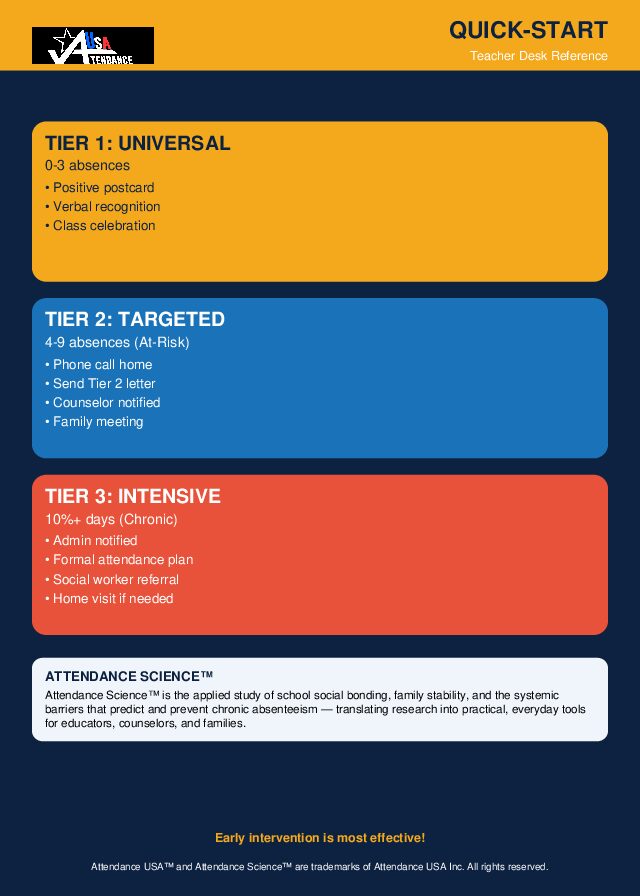
The Quick-Start card, part of the Attendance USA™ Teacher Kit. View front and back (PDF).
- Front: three tiers, early. Tier 1 (0–3 absences) celebrates presence. Tier 2 (4–9 absences) brings a phone call, a letter, the counselor and a family meeting. Tier 3 (10 percent or more) brings an attendance plan, a social worker referral and a home visit if needed.
- Back: beyond the 10 percent. The card routes each absence by its reason, ahead of any threshold: barriers go to the counselor immediately, medical absences to the nurse and the 504/IEP team, and housing instability to the McKinney-Vento liaison. Two absences a month already adds up to 18 a year, and every absence counts, excused or unexcused.
To bring Quick-Start cards to your teachers, write to info@attendanceusa.org, or download the card free from the Free Kit Downloads.
Share it: Two absences a month = 18 a year = chronic. Our Quick-Start card helps teachers act early and route every absence by its reason, from the nurse to the McKinney-Vento liaison.
New: The Science of Showing Up! Blog Series
Attendance USA™'s new blog series translates attendance research into action for educators, families, policymakers and partners. The first post, The Ride Before the Bell, by Dr. Carolyn Gentle-Genitty with Jessica Anderson, M.Ed., Executive Director of Count ME In, treats transportation as an attendance access system: what state law requires, when the parent is the bus, and a bright spot from Brewer High School in Maine. Read it here. Researchers and practitioners are invited to contribute; write to info@attendanceusa.org.
Share it: When the parent is the bus, attendance depends on a family's whole morning. Read The Ride Before the Bell, the first post in The Science of Showing Up! series.
Free Resources: The Seat Series
The Seat Series is free at attendanceusa.org/seat-series: 53 modules across nine audiences, each with a 10-slide deck, the slides as a PDF and two one-page handouts (a "do this Monday" checklist with a script, and a Find Your Data worksheet with a 30, 90 and 180-day roadmap). Modules are released in waves through January 2027, starting with one seat for every audience. This week's spotlight is for administrators:
- Seat 20, No Empty Seats: Four Commitments for Leaders
- Seat 21, Policy That Classifies: changing your attendance policy and first letter
- Seat 22, Climate Is an Attendance Strategy: leadership choices that make a school worth showing up for
- Seat 23, Discipline That Keeps Students Present
- Seat 24, The Board-Ready PRESENCE Case: turning attendance data into a fundable case
- Seat 25, Funding the Work: no-cost, low-cost and partner-funded moves
Modules are also built for teachers (K–2, 3–5, 6–8 and 9–12 editions), practitioners, McKinney-Vento liaisons, technology and data teams, attendance teams, health professionals, parents and guardians, and colleges. Free to use and share with attribution.
Share it: 53 free modules, nine audiences, one goal: every seat filled. The Seat Series is free at attendanceusa.org.
Attendance USA™ in the Field
ParentSquare Webinar | Wednesday, October 28, 2026, 3:00 p.m. ET (45 minutes). Why Students Are Not Showing Up: A Conversation on Attendance and Family Engagement. Dr. Gentle-Genitty and Alex Meis, Vice President of Attendance Strategy at ParentSquare, discuss what districts are learning, why family stability and strong family partnerships sit behind so much of the progress, and what to do instead of the next warning letter. Live Q&A to close. Register now.
Share it: Join Dr. Gentle-Genitty and ParentSquare's Alex Meis on Oct. 28 at 3 p.m. ET: Why Students Are Not Showing Up. What to do instead of the next warning letter.
Where Attention Should Be Right Now
- Ask seniors why. Indiana's answer was relevance. A five-question survey of your own juniors and seniors will tell you yours.
- Code the reason. Pair every absence with a reason code so the pattern behind the 10 percent becomes visible.
- Measure growth and belonging. Track social-emotional growth and climate alongside attendance, and give them a full year.
- Put Medicaid renewals on the family-support calendar. Share navigator contacts before 2027 renewals begin.
- Put the Quick-Start card on every desk and start one Seat this week.
For Parents & Families
If your teen says school feels pointless, ask what would make it worth the trip: a class, a person, a goal. Then share that answer with one adult at school. If your family's health coverage is changing in 2027, ask your school counselor or social worker who can help with the paperwork. Seven free Seat Series modules for parents and guardians are at attendanceusa.org/seat-series.
Share it: Parents: if your teen says school feels pointless, ask what would make it worth the trip. Then tell one adult at school.
Field Notes: On Relevance
A senior who sees no reason to come is giving us data.
A middle schooler who grows in confidence is giving us a forecast.
A parent facing a new renewal date is giving us a warning.
Each is a signal worth answering before it becomes an absence, and each points past the 10 percent toward the conditions that make showing up possible.
Don't just count absence. Understand it.
Have we created a place worth showing up for?
Ask the Brief: send your question to info@attendanceusa.org with the subject line "Ask the Brief."
About this briefing
The Attendance USA Research & Practitioner Briefing is published biweekly to provide educators, researchers, and policymakers with timely, evidence-informed summaries of national attendance and absenteeism trends. Each edition synthesizes peer-reviewed research, state and district reports, policy updates, and practitioner insights from across the United States. Attendance USA was founded by Dr. Carolyn Gentle-Genitty, a leading international authority on school attendance, absenteeism, and the SALT theory model.
Submit a resource or update
Do you have research, a promising practice, data release, or event to share? We welcome submissions from practitioners, researchers, and district leaders across the United States.
Submit to: info@attendanceusa.org
Browse the archive
Every briefing, organized by month
Each week’s briefing has its own shareable page. New editions appear at the top as they publish.
October 2026
Week of Oct. 26, 2026Latest
Beyond the 10 Percent
Week of Oct. 19, 2026
The Room Around the Child
Week of Oct. 12, 2026
The Ride Before the Bell
Week of Oct. 5, 2026
Attendance Is a Signal
September 2026
August 2026
Week of Aug. 31, 2026
Progress, Policy & the Power of Belonging
Week of Aug. 24, 2026
Connecticut’s Home-Visit Gains, a Growing Policy Divide, and AI Enters Attendance Outreach